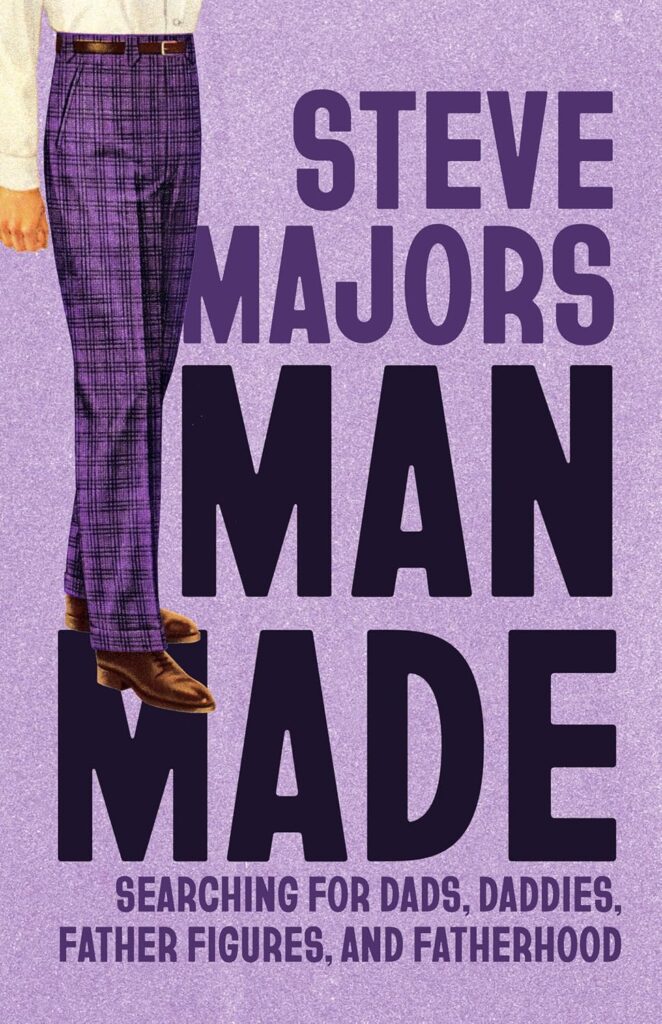
Man Made
Searching for Dads, Daddies, Father Figures, and Fatherhood
 Buy the Book:
University of Wisconsin Press
Amazon
Bookshop.org
Barnes & Noble
Published by: University of Wisconsin Press
Release Date: October 28, 2025
Pages: 184
ISBN13: 978-0299354145
Overview
Not all little boys want to grow up to be like their dads. The shy ones, the sensitive ones, the ones people mock as strange or call queer—sometimes they want to grow up to be loved by men who stand in for their fathers. They’ll put up with bullying from an older brother, taunts from the gym teacher, long work hours from a boss, and even discipline from a gay daddy, all as a means to discover what kind of man they truly want to be.
In this poignant and provocative memoir, Steve Majors takes us on a journey of his own self-discovery as he grows from a gay boy in search of a father figure to a gay man grappling with what it means to be a father himself.
Add on Goodreads
Praise
“With moving, honest, and incisive prose, Majors unravels his lifelong search for father figures, family, and allies, as he comes of age as a gay, Gen X, multiracial Black man—and eventually becomes a father himself—in a wounded and closeted world.”
—Anne Liu Kellor, author of Heart Radical: A Search for Language, Love, and Belonging
“A quest of self-discovery told with aching tenderness and layered insights, Majors’s Man Made captivates while providing context for a rethink of one’s own notions of maleness.”
—Jeffrey Dale Lofton, author of Red Clay Suzie
“Steve Majors writes from experience with a clear eye and a steady hand. I trust him: he is blunt about his mistakes and open about his loves. This book is a glorious reminder that life has no instruction manual—you figure it out as you go.”
—James Whorton Jr., author of Angela Sloan
Excerpt
FATHER FIGURE
My search for a father figure begins long before I realize my father isn’t related to me. The man I call Pops, I learn too late, is just my mother’s husband. He’s also emotionally distant and physically unavailable to me- passed out drunk at home, locked up in jail, or out of town with a secret second family. That leaves my big brother, Jim, or Jim-Jim, to fill in. Unlike Pops, Jim-Jim can be counted on to do dad-like things. He mows our huge crabgrass-filled lawn and rake the leaves into a pile, then burns them with kerosene. Ma depends on him to carry in the groceries when she can afford to buy them and takes on odd jobs when she can’t.
Jim has other duties as assigned. That includes using his Fred Flintstone-like yell and club-like fists to keep us other four kids in line. Though he sometimes smacks my sister and brothers hard on the back of the head or punches them in the chest until they cry, Jim looks out for me.
After all, I’m the baby - 11 years younger than him.
Because I’m little, Jim and I share a bed. I love the way the entire bed sinks under his football player body. At night, zipped into my footie pajamas, I roll toward him from the high outer banks of the mattress into the middle trench where he lies sleeping. I keep trying to skitter myself out of that hollow and toward the side of the bed that hugs the wall, but it’s no use. I always end up next to his body, a hot, heaving mass that feels like a furnace. Sometimes when I wake up in the morning, the sides of my pajamas are soaked with our sweat. Other times when I snuggle up next to him, I touch my cold bottle to his hot cheeks while he sleeps. Sometimes, my aim misses, and the opening in the rubber nipple rubs his face, and a few drops of whole milk splashes him.
When that happens, he shakes awake with a snort. “Jesus Christ, give me that goddamned thing. You’re not a baby anymore.” But at four, I don’t think I’m too old for my bedtime “ba-ba.” I’m still a baby.
We are both Mama’s boys. But we couldn’t be more different. I want to curl up on my mother’s lap for hours, stroking her face and twirling her hair. I lay my head into the crook of her neck, where I smell the talcum powder on her body and the mix of Juicy Fruit, Viceroy cigarettes, and black coffee on her breath. “Get down,” Jim yells when he sees me this way. “Stop acting like a sissy.” He grabs my waist, but I hang on tight and bury my face harder into my mother’s neck. Jim’s grip can easily pluck me free, but he stops after I start whimpering, and Ma tells him to leave me be. Jim eyes me with suspicion. He knows I like burrowing my face into small spaces and sniffing hard. All little kids have their tics. But mine are odd. For a year, I line up everyone’s shoes near the kitchen door and go down the line, pulling the dark, dank shoe openings to my nose. I place my tongue across the roof of my mouth and then inhale hard. The snore-snorting sound makes everyone laugh at first. A year later, everyone will be hiding their shoes from me, afraid, as Grandma might say, I am “teched” or touched in the head.
But Jim only rolls his eyes at my me. At least until I place my nose in one spot that finally earns my first punch from him. We are in the basement that day. The few bare bulbs on the ceiling throw weak pools of yellow light across the cement floor. The big kids play ping pong on a table Pops has impulsively and drunkenly bought with most of Ma’s work check. “Suh-nip, Suh-nap. Suh-nip, Suh-nap. Suh-nip, Suh-nap.”
I grow bored watching the back and forth, so I jump off the bottom step and walk toward a duffel bag in the corner. I recognize it. Every day, at the end of football practice, Jim throws it down the stairs leading to the basement so his sweaty gym clothes are closer to the washing machine. “Suh-nip, Suh-nap. Suh-nip, Suh-nap.” As the big kids follow the ping pong ball, I tug the duffel bag’s zipper back and forth on the bag making my own rhythmic sound. Finally, on the sound of “zuht,” the teeth lay open, and I plunge my tiny hand into the bag. I pull Jim’s cold and wet football jersey out and lift it to my nose and inhale deeply. It smells familiar, just like Jim-Jim after practice. Next, out come his cleats, with tufts of mud and grass still stuck to the bottom. Jim is still distracted by ping pong. “Suh-nip, Suh-nap.” I take a big inhale of his cleats, snort, and then close my eyes. I snap them open suddenly to ensure the other kids don’t notice and take them away. My hands plunge in again and pull out some kind of slingshot. I hold the pouch of damp cloth in one hand and pull two elastic loops back with the other, stretching it like a rubber band. I’m confused by it. I place it back in the bag and pluck up an oval piece of white plastic. It’s shaped like a mask - narrow at the top for my nose and wider at the bottom for my mouth. There are holes across it like the oxygen masks I see on TV shows, like Marcus Welby M.D. or Emergency. Without a second thought, I place it over my nose and mouth then inhale. “Suh-nip, Suh-nap.” SMACK. I hear the paddle slam on the table. Jim-Jim is storming across the basement like a bear, and his fists are curled tight at his side. He snatches the mask off, whips it across the room, and places his face inches from mine. “WHAT THE FUCK IS WRONG WITH YOU?” He punches my shoulder hard, and the other kids burst out laughing. For the first time in my life, Jim-Jim is mad at me, really mad. I feel I’m supposed to be embarrassed by what I’ve done. I run upstairs, my face streaked with tears and snot, and bury it against the leg of Ma’s polyester pants.
Even though I know I’ve disappointed Jim, he still refuses to let my siblings or anyone else make fun of me. On the following Saturday, he decides I need to understand football. He carries me on his shoulders while I hold his duffel bag, and we stalk across the practice field. He plunks me on a bench, where I shade my eyes against the sun. I swing my legs back and forth, watching him do drills and scrimmages with his high school football squad. At the end of one practice, a gaggle of white boys follows him to get their water bottles and bags. I sit with my little legs crossed at the knee. One boy sweeps his long, shoulder-length brown hair out of his eyes and looks me up and down. “This your brother?” he asks Jim. “What did you do, dunk him in bleach or something?” Jim grits his teeth, then slams the helmet in his hand really against the boy’s shoulder pad. “Shut your fucking mouth,” he growls. Then he squats backward toward the bench where I sit so I can jump on. I swing my hands around his neck and clamp them tight under his chin and then try to curl my legs across his broad back. They are too short to meet up in the front. As we walk off the field, I feel the sweat drip down his face and onto my arms. It feels like tears.
As I grow older, Jim begins to demand something for his protection. He tells me I need to defend myself and throws punches at me. “Clench your fists, goddammit.” I cover my face and cower. Boxing lessons are soon followed by sports practice. He drags me out to the front yard after school and hurls footballs at my chest over and over again. As they slam into my fingertips or right into my chest, I yell in pain and drop them. I back away from his pitched baseballs and wiggle ineffectively beneath his high school wrestling moves. I think back on the days his body cocooned me in sleep, but now it just tries to cow, crush, or suffocate me.
Jim gives up on his athletic dreams for me as the years pass. But he continues his goal of making me a man. There are constant offers to sip his beer, take a drag on his cigarette, have a hit of his reefer, or steer his muscle car from the passenger seat. Each time I fail, but I know better than to cry. When I’m old enough, his manhood lessons also include advice on getting girls to like me. But instead of trying to get a girlfriend of my own, I gossip and become besties with all of his, including the women he marries. I no longer have to fear his brotherly punches or headlocks. Now I just know he will shake his head at me in disgust or disapproval.
Decades go by, and our lives grow increasingly apart until we come together to watch our mother die. We are both still mama’s boys, wanting to please and protect her. But this time, we know we have failed. While we have grown over the years, she has shrunken under the weight of an abusive marriage, a demanding job, and far too many Viceroys and cups of black coffee to count. When she dies, I cry like a baby. So many tears come they fall inside of me – some bitterly backing down my throat and others pouring through my nose.
I sit down next to Jim at her funeral and we are shoulder to shoulder, closer than we have been in years. He takes a deep breath and grabs my arm hard enough for it to hurt. “Stop crying,” he demands. “Jesus Christ, be a man.” In his eyes, thirty-three is too old to sob like a baby. At that moment, I am reminded of the differences between our definitions of manhood. I cry for the boyhood that I have lost. He doesn’t because of the man he has become.